
Counseling Programs offered at University of Rochester
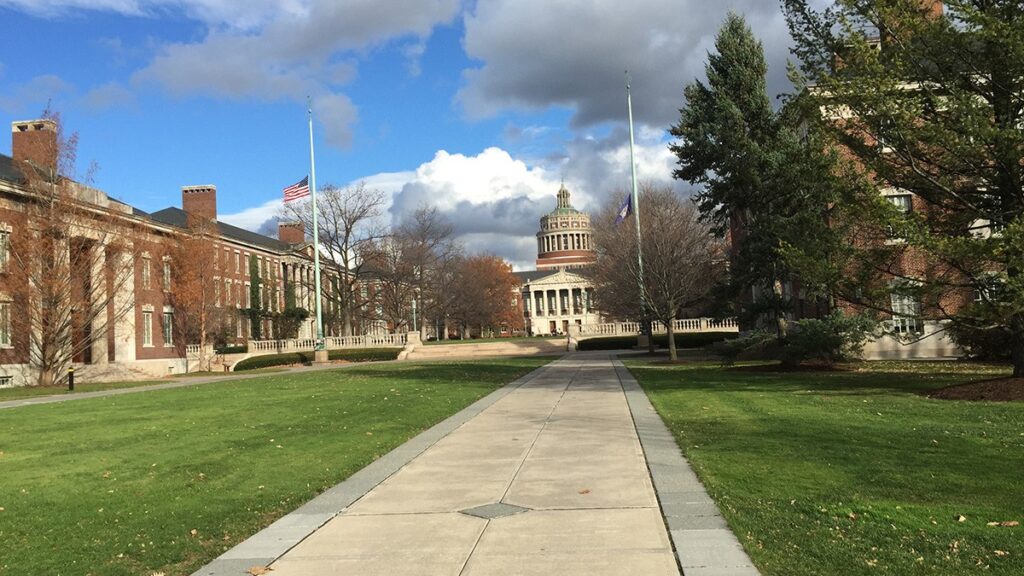
Warner School at the University of Rochester runs CACREP-accredited counseling programs that prepare professionals who can address the range of social-emotional, academic, career, and developmental needs of student populations. The programs train people to pursue leadership roles in schools and clinical settings. They function as facilitators of healthy human development and promote systemic change.
The Counseling Program at Warner School maintains a two-fold mission. First, it educates counselors who will strengthen their clients and students to create more rewarding and meaningful lives and relationships. These counselors become more self-reflective, caring, and compassionate persons who contribute to reform of the systems in which their lives are embedded. Second, the program prepares counselor educators, researchers, practitioners, and leaders in the counseling profession. These professionals will educate the next generation of counselors and contribute new knowledge in the fields of counseling and human development. They will lead reforms in educational and social systems to promote healthy human development and quality relationships.
This mission operates from an ecological view of professional counseling. The approach acknowledges the importance of personal development while recognizing that lives are embedded in a variety of personal and extended relationships and social systems. So the program views human development, counseling, and education within historical, cultural, and social contexts. Faculty work to encourage healthy development across the life course and across an array of capabilities.
The program sees the integration of biological, psychological, and social intervention as a foundation for enduring and just human development and change. Counselors are recognized as agents of institutional change and personal empowerment. The program welcomes the richness of traditions, disciplines, practices, and cultures that generate counseling resources. It embraces difference and breakthroughs. More, the latest research guides best practice and intervention strategies throughout the curriculum.
Students can pursue master’s degrees in school counseling and clinical mental health counseling. Both are CACREP-accredited programs that prepare graduates for licensure-eligible positions. The school counseling track prepares people for certification in K-12 public schools. New York State offers two certification levels: Initial Certification and Professional Certification. The mental health counseling program trains clinicians who are dynamic, culturally attuned, and prepared to address growing societal pressures and mental-emotional distress. Warner School offers CACREP-approved doctoral programs in counseling if you have advanced credentials. These programs are designed if you’re pursuing careers as counselor educators, faculty members, or research leaders in the counseling profession.
What counseling programs does University of Rochester offer?
The university structures its Rochester counseling offerings at three program levels: master’s degrees, doctoral degrees and advanced certificates. Students can pursue either a School Counseling degree or a Clinical Mental Health Counseling degree at the master’s level. Both require 60 credits for full completion. The School Counseling program offers flexibility with a 48-credit option that provides the shortest path to New York State provisional certification. The 60-credit track meets all coursework requirements for both provisional and permanent certification.
The mental health counseling degree prepares license-eligible practitioners to work in a variety of settings. Students complete rigorous didactic coursework and 700 hours of field-based internship and practicum experience. Graduates become eligible for a New York State Limited Permit to practice as mental health counselors in state-defined settings upon program completion. The curriculum is registered with the New York State Office of Addiction Services and Supports as a 350-hour CASAC education provider. Each graduate can earn a CASAC-Trainee credential.
Doctoral-level counseling programs at University of Rochester include a PhD in Education: Counselor Education and Supervision, an EdD with Specialization in Counseling and an EdD in Mental Health Counseling. These programs require a minimum of 96 graduate credits that include doctoral-level internships. The PhD prepares graduates for academic positions in universities and research roles in government agencies. The EdD programs support experienced counselors pursuing leadership positions and selected higher education faculty roles. Students can become eligible for New York State mental health counseling licensure through the EdD in Mental Health Counseling, which offers additional coursework beyond the 96 required credits.
Advanced certificate options provide targeted training for professionals with existing degrees. The 24-credit Advanced Certificate Bridge from School Counseling to Clinical Mental Health Counseling requires six mental health counseling courses and two internships. A 12-credit bridge program moves professionals from mental health to school counseling and requires two school counseling courses and two internships. The university also offers an Advanced Certificate in Addictions Counseling through collaboration between the Warner School and Strong Recovery and a Post-degree Certificate Program in Marriage and Family Therapy for professionals holding advanced degrees.
Internships/Practicum at University of Rochester
Practical training is the substance of counseling education at University of Rochester, with distinct requirements spanning master’s and doctoral levels. Master’s students begin their clinical experience through a Counseling Practicum requiring 100 hours of supervised fieldwork, split between 40 hours of direct client service and 60 hours of indirect activities. This original commitment spans one full day or two half days weekly across 14 weeks at an approved site. Students work under dual supervision from both site supervisors and university faculty, transitioning from observation to independent practice over time.
Students advance to their internship experience after practicum completion, which just needs a minimum of 600 clock hours with at least 240 hours dedicated to direct clinical service. Students may continue at their practicum site if all parties consent, or they can pursue new placements in a variety of settings like outpatient facilities, integrated care centers, residential programs and educational institutions. Weekly supervision remains mandatory, with students receiving at least one hour of clinical oversight plus participation in group and triadic supervision sessions.
The University Counseling Center operates an APA-accredited doctoral internship program offering five positions each year. This intensive program provides 2,000 hours of supervised experience in health service psychology. Applicants must hold enrollment in APA or CPA accredited programs, complete three years of graduate work, accumulate at least 200 hours of individual therapy experience with adults and finish their exams before application.
Doctoral interns receive five hours of weekly supervision, divided into three hours of individual sessions and two hours of group oversight. Clinical responsibilities cover time-limited psychotherapy, year-long group therapy facilitation, assessment for treatment planning, on-call emergency services and campus outreach initiatives. The apprenticeship model emphasizes increases in professional responsibility while developing competencies in assessment, intervention and multicultural practice.
What sets University of Rochester apart?
Recognition from U.S. News and World Report positions Warner School at #100 among 258 evaluated graduate education programs nationwide. This marks a 36-spot advancement over five years. The upward trajectory reflects the school’s location within a Tier 1 research university where faculty conduct some of the highest volumes of research activity in the United States. Faculty members lead change in education, counseling and human development fields. They center their work around four specialized centers that advance education and better community lives.
The counseling programs hold CACREP accreditation through March 31, 2028. This represents the third consecutive accreditation cycle and among the highest acclaims an academic program can receive in the counseling field. The MS in Clinical Mental Health Counseling, EdD in Mental Health Counseling and Supervision, and Advanced Certificate Bridge Program have all received Diagnostic Privilege Designation from New York State. This goes beyond standard accreditation.
Assessment data demonstrates consistent excellence. Students score within the “exceeds expectations” range on all measures, with site supervisors rating MS students at 3.48 out of 4. This is an increase of 0.27 from the previous year. Cultural competence receives emphasis from introductory courses onward. Warner School’s Social Justice mission nurtures this, and all counseling courses discuss it. Students can access AI and VR simulation resources through URochester’s Studio X. The platform offers optional AI-supported role-play with simulated clients.
Getting Started
Prospective students can begin their application experience by taking a course before formally applying to counseling programs at University of Rochester. Warner School offers discounted pricing for these preliminary courses, with credits that apply toward degree requirements. You can experience the program firsthand while building your academic foundation with this approach.
Application deadlines vary in a variety of programs. Master’s students targeting fall admission should complete applications by May 1 for most programs, though the MS in Genetic Counseling requires submission by January 3. The Medical Pharmacology, Medical Physics, and Health Humanities programs extend their deadlines to June 15. PhD applicants face a December 1 deadline. Some programs accept rolling submissions until January 1.
Warner School requires a $70 application fee. You must submit transcripts from all postsecondary institutions, two recommendation letters for master’s applicants, a double-spaced statement of purpose (two to four pages), a current resume or CV, and a five-page writing sample with citations. Graduate Education programs charge $60 for applications.
Master’s programs send admission offers between May and June 30. Responses are due by July 1. Keep in mind that NYS Justice Center mandates background checks for all clinical trainees before matriculation. Interview invitations occur on a rolling basis, with February interviews for early completions.