
St. John Fisher College Counseling Programs
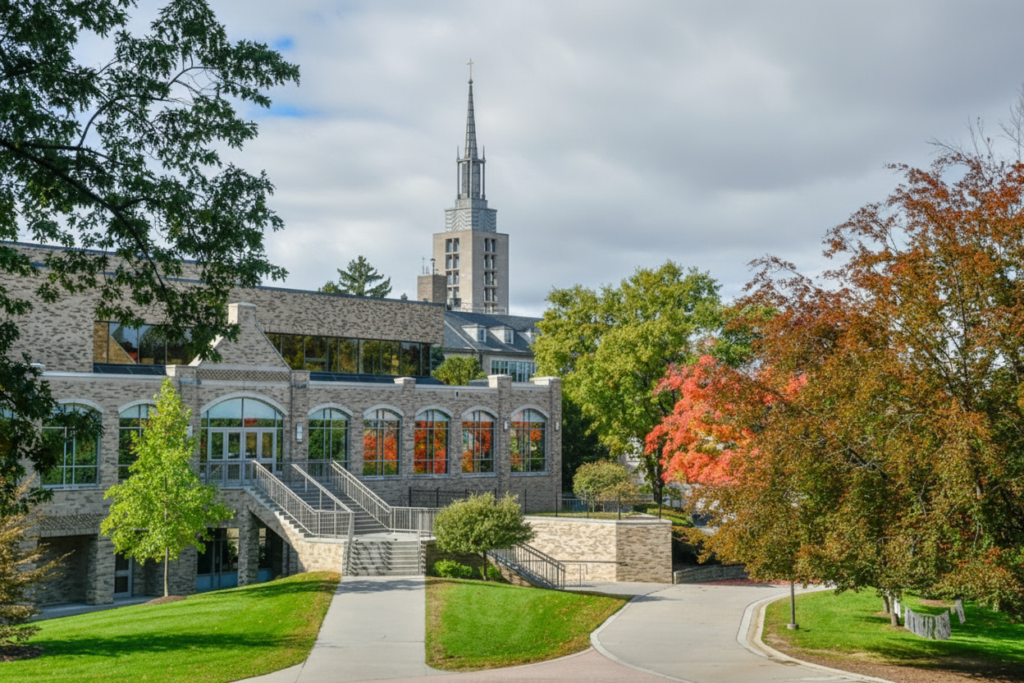
St. John Fisher University’s mental health counseling program operates with a focused mission: to deliver culturally informed, individual-specific instruction to a diverse student body regarding everything in counseling knowledge and skills. The program goes beyond technical training by helping the development of personal qualities you need to become an outstanding professional mental health counselor.
This program will license you to treat adults and children facing emotional, mental and physical challenges. The curriculum gets into the psychological foundations of mental health among other related developmental issues. Diagnostic assessment serves as a focal point, with particular attention paid to both its strengths and limitations. The program emphasizes individual and family strengths to help recovery and resilience when challenges arise.
Fisher’s mental health counseling program holds accreditation from the Council for Accreditation of Counseling and Related Educational Programs (CACREP). This accreditation provides recognition that the content and quality of your education has been reviewed and meets standards set by and for the profession.
The program offers two distinct pathways. The Master of Science degree requires 60 credit hours, which you can complete in 20 months through full-time study or 32 months part-time. Professionals who already possess a master’s degree in counseling or a related discipline can choose the Advanced Certificate option. This is the quickest way to build upon your existing foundation. This certificate requires 18 credit hours, including 12 credits of coursework and 6 credits of supervised internship that just need a minimum of 600 clock hours providing mental health counseling services in an approved clinical setting.
Courses offer in-depth, practical insight into professional identity, social and cultural diversity, human growth and development, helping relationships, career development, group work, research, program evaluation and evidence-based intervention skills. Late afternoon and evening classes enable you to work toward your degree or certification with minimal disruption to your schedule.
The program prepares you for work in settings of all types, from community agencies and clinics to hospitals, managed behavioral health care organizations, outpatient mental health programs, residential treatment facilities, substance abuse treatment programs, employee assistance programs, colleges, universities and private practice. Graduates benefit from a 97% placement rate and work in mental health care settings on local, regional and national levels.
What counseling programs does St. John Fisher College offer?
St. John Fisher’s mental health counseling program curriculum prepares students to meet specific professional competencies. The program structure will help you develop five core capabilities:
- Demonstrate professional skills and personal qualities required to work as an effective counselor in an integrated setting
- Use a variety of differential diagnostic assessment skills consistent with the most current diagnostic manual
- Apply a diverse range of evidence-based intervention strategies
- Develop appropriate intervention plans based upon knowledge of culturally relevant variables in client care, including ethnicity, religion, gender, sexual orientation and disability status
- Exhibit professional behavior consistent with ethical guidelines of mental health counseling professional organizations and regulatory agencies
The master’s degree requires 60 credit hours distributed across 18 courses. Core coursework has GMHC 500 (Mental Health Counseling as a Profession), GMHC 510 (Counseling Theories and Strategies), GMHC 515 (Social and Cultural Diversity) and GMHC 520 (Assessment in Counseling). Additional required courses cover psychopathology, treatment planning, group theory and research methods. You’ll also study biological foundations of behavior, psychopharmacological interventions and family counseling. Crisis and trauma counseling plus substance use counseling round out the requirements. You will complete a 3-credit practicum (GMHC 550) and a 9-credit internship (GMHC 650), plus one elective course.
Fisher’s undergraduate psychology majors can access a five-year accelerated pathway. This option allows you to complete your undergraduate degree early and transition into the graduate program during your fourth year.
You should ideally have completed undergraduate courses in abnormal psychology, developmental psychology and research methods before enrolling. Theories of personality, statistics and tests and measurement also strengthen your readiness for graduate-level work.
The Certificate of Advanced Study pathway requires 18 credit hours total: GMHC 500, GMHC 525 (Psychopathology and Differential Diagnosis), GMHC 530 (Treatment Planning and Intervention) and GMHC 585 (Biological Foundations). You’ll also need 6 credits of supervised internship requiring a minimum of 600 clock hours in an approved clinical setting.
Internships/Practicum at St. John Fisher
Field placements need substantial time commitments that shape your experience in the mental health counseling program. The 60-credit program has a supervised practicum with a minimum of 100 clock hours for 3 credits. The internship requires a minimum of 600 clock hours for 9 credits. The typical internship requires 18 hours per week at your agency site. Most placement sites provide services during regular weekday business hours, so you need to plan ahead for this commitment. Completing these critical components in the evening or on weekends is not possible generally.
You’ll develop counseling skills in a specialized training environment before entering field placements. The program uses a 6-room training lab equipped with one-way mirrors, video cameras, video monitors and live observation. This facility replicates actual counseling environments through dedicated spaces for individual sessions, couples or group work and a play therapy room for working with children. You can practice skills and review recordings of your sessions throughout the program regularly. You will have already prepared for work with clients through practice sessions with classmates and volunteer clients by the time you begin field work.
Readiness for clinical placement depends on satisfactory completion of prerequisite academic courses with a minimum 3.0 GPA and faculty determination that you demonstrate essential personal qualities. These qualities are flexibility, respectfulness, receptivity to feedback and capacity to listen. They also include appropriate self-disclosure, organization, reliability and commitment to excellence. Faculty members review your performance on these qualities through written assignments, classroom discussions, peer projects and role-plays.
Students take part in clinical internships throughout the region in different community settings under qualified site supervisors and faculty instructors. You can contact Allison Bosworth, field experiences director, at abosworth@sjf.edu or (585) 385-5220 to get assistance with field experience placements.
What sets St. Fisher College apart?
CACREP accreditation distinguishes Fisher’s mental health counseling program through rigorous quality standards. The program received reaccreditation in 2025, marking the third time CACREP has affirmed the program following previous accreditations in 2008 and 2016. The program met all CACREP standards and received commendations for its student-centered approach to training future leaders in the mental health field. Just as important, the program received a full eight-year accreditation period.
All full-time faculty are licensed mental health counselors in New York State. Faculty members maintain active clinical practices while teaching and bring current field experience into classroom instruction. This combination of academic expertise and practical experience shapes the program’s approach to preparing students for professional practice.
Graduate outcomes show the program works. 93% of admitted students graduated on time in 2023. Also, 100% of the 25 graduates from that year are employed in the field of mental health counseling. More than 475 graduates have entered the workforce in settings of all types at the regional and national levels since the program’s inception.
Pass rates for the National Clinical Mental Health Counseling Exam (NCMHCE) show consistent performance: 80% in 2018, 69% in 2019, 71% in 2020, 71% in 2021, and 60% in 2022. The Golisano Institute Programs in the Wegmans School of Nursing ranked No. 34 among graduate nursing programs in the country.
The program holds approval from the Office of Alcoholism and Substance Abuse Services (OASAS) for the educational component of the Credentialed Alcoholism and Substance Abuse Counselor (CASAC) designation. The curriculum has training for the Integrative Care Initiative in New York state. The Wegmans School of Nursing enrolls more graduate candidates than any other program in New York State outside of New York City.
Next steps
Applications to St. John Fisher’s mental health counseling programs operate on a rolling basis. Your application receives review as soon as it arrives. Admissions decisions typically come within four weeks of receiving a completed application. This efficient process allows you to plan your educational timeline with greater certainty.
Different stages of your decision process require different expertise, so Fisher provides multiple contact points. Marybeth Kula, Admissions Counselor, handles general admissions questions and application guidance at mkula@sjf.edu or (585) 385-8064. Dr. Robert Rice, program chair, answers specific questions about the Master of Science or Certificate of Advanced Study in mental health counseling programs at rrice@sjf.edu or (585) 385-7318.
Admitted students who need flexibility can defer their entrance for one semester by contacting the Office of Transfer and Graduate Admissions. This option provides breathing room if circumstances change between acceptance and your planned start date.
Your path forward starts with completing the online application. The program’s rolling admissions approach means you control your timeline rather than waiting for specific deadline cycles. The four-week review window gives you a clear expectation for when you’ll hear back about your admission status once you submit your materials.