
Counseling Programs at Marist University
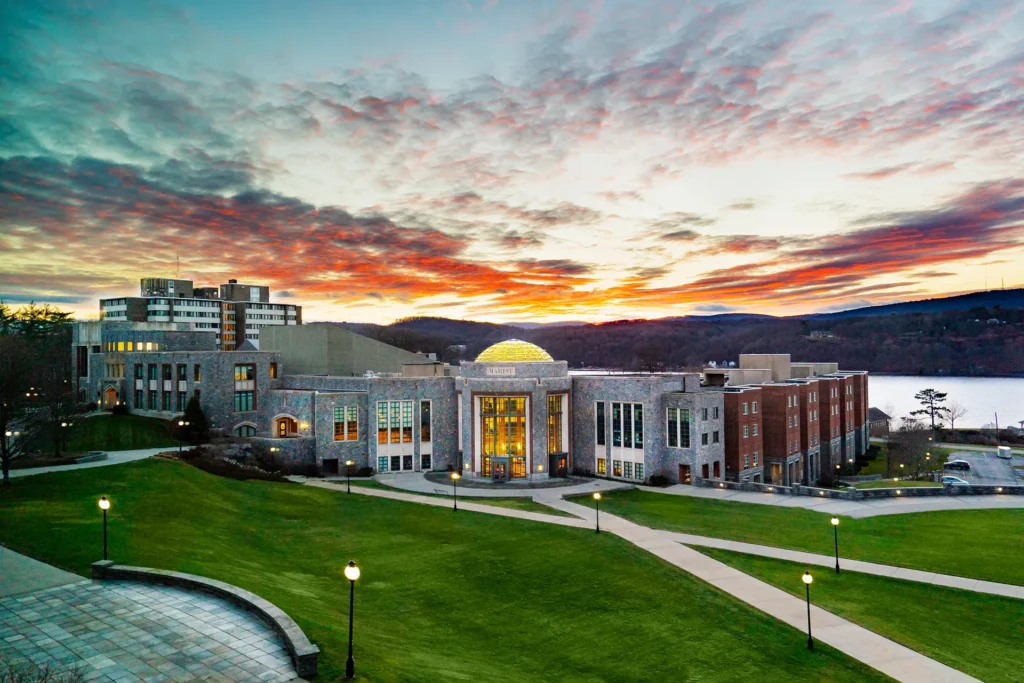
Marist University’s MA in Clinical Mental Health Counseling is a distinctive behavioral health care program that prepares you to become a licensed Clinical Mental Health Counselor. The program makes use of your desire to help those who need mental health care and emphasizes your personal and professional growth. This school’s approach helps you develop self-awareness and learn more about others.
The 60-credit Clinical Mental Health Counseling program exceeds requirements set by the New York State Education Department. You’ll receive instruction in critical areas that most other master’s programs don’t require. These include family and couples counseling, crisis and trauma intervention, psychopharmacology, chemical dependency counseling, and counselor supervision. This broader foundational knowledge helps you better serve your clients in a variety of settings.
You can complete the counseling programs Marist University offers in two distinct formats. The full-time accelerated option spans two years and incorporates two summers with 12-credit hours each fall and spring semester. The three-year schedule offers more flexibility. It has two summers with 9-credit hours during fall and spring semesters of the first two years, then 6-credit hours during the third year.
The outcomes show the program’s effectiveness. In the last six years, more than 95% of students qualified for merit scholarships ranging from $3,000 to $5,000. About 85% of graduates found employment or entered doctoral programs within 3-4 months of graduation in the last three years. Small class sizes averaging 10-12 students allow for deeper instruction and personalized mentoring.
The field of clinical mental health counseling is predicted to grow by 23% by 2030, much faster than average. Marist’s program is registered with NYSED as meeting education requirements for the New York state licensed mental health counselor credential.
What counseling programs does Marist offer?
Beyond the clinical mental health focus, Marist’s School of Social and Behavioral Sciences houses three graduate programs designed for aspiring counselors and school psychologists. Each program within the counseling programs Marist University provides gives you the hands-on skills and theoretical knowledge to succeed in your chosen field.
The MSEd in Contemporary Curriculum and Instruction serves working educators who hold original teacher certification. You can pursue this degree through either online or campus-based models. This allows you to balance professional obligations with academic advancement. The program offers two tracks: Professional Certification in Childhood Education covering grades 1-6, and Professional Certification in Adolescent Education for grades 7-12. Successful completion leads to New York State Professional Teaching Certification.
The MA in School Psychology prepares you to become a New York State Certified School Psychologist credentialed for K-12 schools if you’re interested in school-based counseling work. The program holds accreditation from the National Association of School Psychologists (NASP) and ensures your education meets national standards. Evening classes during your first year allow you to work and study during daytime hours. Since 2015, Marist students have achieved a 100 percent pass rate on the Praxis II exam. The graduating class of 2024 secured employment within six months of graduation. U.S. News & World Report ranks School Psychology among the top 10 Best Science Jobs and top 100 Best STEM Jobs.
Small class sizes across all programs promote improved student-faculty interaction. Financial scholarships, assistantships, and organizational partnerships help reduce tuition costs for qualified candidates. Faculty members bring diverse clinical and educational backgrounds and expose you to multiple viewpoints within each field.
Internships/Practicum at Marist University
Clinical experience forms the bridge between classroom theory and ground counseling practice at Marist. The program structures professional practice through two phases: practicum and internship, both designed to meet NYSED and CACREP requirements.
Your practicum begins during a 10-week summer semester. You participate in supervised professional counseling work approximately 10 hours per week and complete a minimum of 100 hours total. At least 40 of those hours must involve direct client service. This original field experience happens before you transition to internship coursework.
The internship phase follows during fall and spring 15-week semesters. You work about 20 hours per week at your clinical site and accumulate a minimum of 600 total hours. Direct client service must account for at least 240 of those hours. Marist exceeds NY State field experience requirements by mandating a minimum of 700 supervised clinical hours rather than the state’s required 600.
The Clinical Experience Coordinator provides orientation meetings and distributes a Clinical Experience Handbook to both students and site supervisors. This coordinator maintains a complete list of placements offering professional mental health counseling services in a variety of client populations. You can select from hospital mental health programs, community mental health agencies, college counseling centers, residential treatment programs, and substance abuse facilities. Over 50 existing clinical sites are available.
A training agreement formalizes the collaboration between you, your field placement supervisor, and the Clinical Experience Coordinator. A Marist faculty member monitors your field experience and provides group supervision throughout both practicum and internship courses. Site supervision is also part of this arrangement.
You must get student liability insurance before you participate in clinical experiences. Some sites may require health screenings, criminal background checks, or drug screenings to determine eligibility for clinical training.
What sets Marist University apart?
National recognition confirms the quality Marist University delivers through its counseling programs. U.S. News and World Report ranks Marist 2nd in Best Undergraduate Teaching within the Universities North region, a jump from 16th place the previous year. The institution also secured 10th place in overall Best Regional Universities North rankings. Marist earned a top-five position in the Most Innovative category for the fifth year running and currently ranks 4th. The Princeton Review acknowledges Marist among the nation’s best across student satisfaction, student happiness, and residential life.
The Clinical Mental Health Counseling program carries its own recognition. Marist received approval as one of the first programs meeting education requirements for New York Licensed Mental Health Counselors. The program holds regional accreditation through the Middle States Commission on Higher Education, recognized by the Council on Higher Education Accreditation. The program plans to apply for accreditation from the Council for the Accreditation of Counseling and Related Educational Programs (CACREP), the premier accreditor of counseling programs.
Faculty expertise strengthens your educational experience. Faculty members bring clinical backgrounds as licensed mental health counselors or psychologists from various fields. The program follows a practitioner-scientist training model and creates opportunities for faculty-student research collaboration. These partnerships allow you to showcase research at counseling conferences.
Graduate outcomes show the program works. Marist counseling program graduates’ pass-rate surpasses that of most other New York counseling programs. Marist’s reputation has built connections with clinical sites of all types and provides you access to varied training environments that prepare you for professional practice.
Next steps
Application to counseling programs Marist University provides starts with GradCAS, a centralized application service for all graduate programs. You create an account through the online portal and select Fall as your term, Marist University as your institution, and MA in Clinical Mental Health Counseling as your program. The application deadline falls on May 15, though the admissions committee reviews applications received after this date on a case-by-case basis.
Your complete application requires several components. Upload your unofficial transcript from your bachelor’s degree-granting institution to receive an admission decision. You’ll need to submit an official transcript showing your bachelor’s degree to matriculate after acceptance. A current resume is required along with a personal statement of at least 500 words that outlines your educational background and reasons for selecting Marist’s MA in Clinical Mental Health Counseling program. You must also provide three letters of recommendation with at least one from a current or former professor. The Graduate Record Examination (GRE) is optional. You’ll pay a $50 application fee online.
The program director conducts an interview starting in February. Verify you’ve completed prerequisite coursework in Introduction to Psychology, Statistics, and Research Methods in Psychology or Social Sciences before acceptance. Abnormal Psychology is preferred. All courses require grades of 3.0 or better.
Transfer credits from CACREP accredited programs may apply and allow up to six credits with a minimum grade of 3.0.