
Alfred University Counseling Degrees
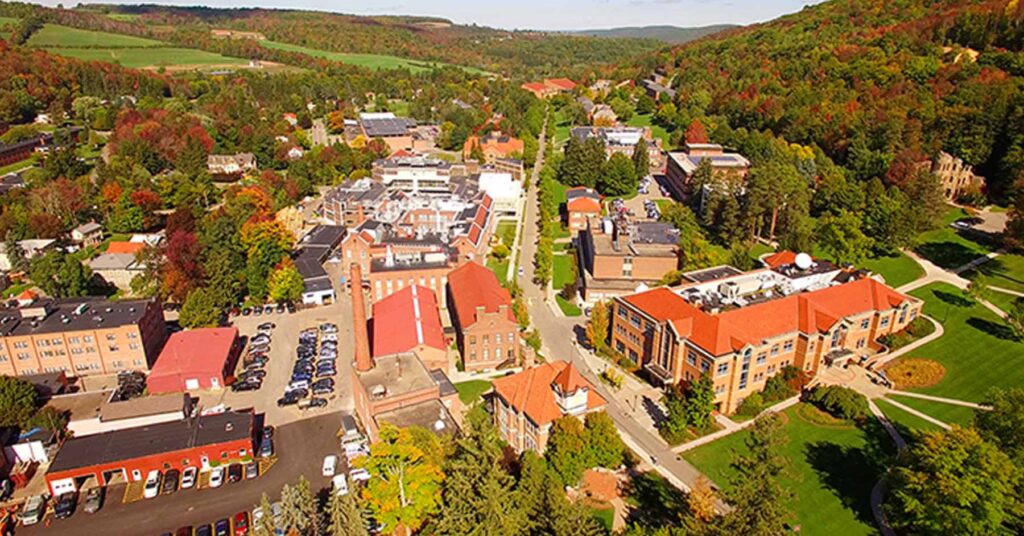
Alfred University stands in the Allegany foothills of southwestern New York State as a private, non-sectarian institution with deep roots in progressive education. Independent thinkers who valued available education for all citizens founded the university in 1836. Alfred University distinguished itself early as the oldest coeducational college in New York State and the second oldest in the United States. The institution enrolled African American and Native American students during the nineteenth century.
The institution has grown into a complex university. Programs span liberal arts and sciences, art and design, engineering, business, education, student affairs, and counseling. Alfred University serves approximately 1,600 undergraduate and nearly 150 graduate students at present. This small size creates a strong sense of community. Tailored education runs on close faculty-student relationships.
The Division of Counseling and School Psychology operates within the School of Graduate and Continuing Studies (SGCS). The division prepares graduate students for leadership roles in education, student affairs, school counseling, clinical mental health counseling, school psychology, and public administration. Faculty members bring extensive professional and career experiences combined with dedication to student development. They guide students through their educational and professional paths.
Alfred University counseling programs include CACREP-accredited offerings in Clinical Mental Health Counseling and School Counseling. CACREP accreditation confirms that program quality meets the highest professional standards. Students receive relevant knowledge and skills throughout their curriculum. The mental health counseling field shows strong growth potential. Jobs are projected to grow 19% over the next decade, much faster than the average for all professions.
Alfred University offers Certificate of Advanced Study (CAS) options beyond traditional master’s degree programs. These programs serve those who hold master’s degrees in counseling but need additional credentials. The bridge programs serve specific purposes. The CAS in School Counseling targets those seeking New York State school counseling certification. The CAS in Mental Health Counseling helps counselors meet licensure requirements.
Programs accommodate different student needs through multiple delivery formats. On-campus programs operate in Alfred. Off-campus locations serve students in Brooklyn at St. Francis College and in Westchester and Oceanside on Long Island at The College of St. Rose. Off-campus programs feature weekend class schedules designed for working professionals. Cohorts move through coursework together.
What counseling programs does Alfred University offer?
Alfred University counseling programs center on two main degree pathways: Clinical Mental Health Counseling and School Counseling. Both tracks lead to a Master of Science in Education (MS Ed) and Certificate of Advanced Study (CAS) and require completion of 60 credit hours. This credit structure will give students all educational requirements for their respective certifications while receiving detailed preparation for professional practice.
The Clinical Mental Health Counseling program addresses eight common core curricular experiences among specialized training in foundations of mental health counseling, psychopathology and differential diagnosis, counseling special populations with evidence-based practices, mental health assessment, substance use disorders, and trauma-informed care. Students involve themselves in practicum and internship courses spanning three semesters and accumulate over 700 hours of applied experiences in community mental health agencies and college counseling centers. Graduates complete all educational requirements to get their limited permit as a Mental Health Counselor. This positions them for full licensure (LMHC) after accumulating required post-graduate contact hours and passing the National Clinical Mental Health Counseling Examination.
The School Counseling program provides eight common core curricular experiences with specializations that include foundations of school counseling, exceptionality and mental health, evidence-based interventions in schools, consultation and prevention, and college counseling and advising. Field experiences total over 700 hours across three semesters in elementary, middle, and high school settings. Students receive provisional certification as New York State school counselors upon completion and have fulfilled all coursework for permanent certification requirements.
Alfred University counseling offerings include bridge pathways through Certificate of Advanced Study programs beyond these master’s programs. The CAS in Mental Health Counseling serves those who hold master’s degrees in counseling fields such as school counseling, community-agency counseling, or college counseling but lack specific coursework for mental health licensure. This 18-credit program consists of four classroom-based courses and two internship courses spanning three semesters and requires 600 clock hours of experience with 240 hours with direct client contact.
Internships/Practicum at Alfred University
Field experiences are the foundations of practical training within Alfred University counseling programs. The structure is different between mental health and school counseling tracks, yet both emphasize supervised clinical work that bridges classroom theory with ground application.
Mental health counseling students begin with a practicum requiring 100 total hours, 40 of which involve direct service with clients at selected clinical agencies. You work under supervision of a licensed mental health clinician. At the same time, you provide counseling services at Alfred University’s Child & Family Services Center under program faculty supervision. You advance to a two-semester internship sequence after practicum completion. Hour requirements increase significantly here. The internship needs 600 total hours with 240 hours of direct client contact, distributed across both semesters at 300 clock hours and 120 direct service hours per semester.
School counseling students enrolled in downstate or extension programs follow a distinct practicum timeline. You complete two practicum experiences with escalating time commitments during your second year. The fall practicum requires seven hours per week of school counseling activities. The spring semester requires 14 hours weekly. Both experiences operate under supervision of certified school counselors. You accumulate approximately 300 contact hours of supervised school counseling experience at completion of your second year.
Site selection responsibilities rest with you as the student. You identify potential placements, whether mental health agencies, school districts, or college counseling centers. Sites must meet specific criteria: mental health internship supervisors hold licenses as LMHC, psychologists, or LCSW, while agencies require appropriate state licensing through OMH or OASAS, or operate as PC, LLC, or LLPC professional practices. Sites sign formal internship agreements with Alfred University before you begin.
Weekly seminar classes accompany your fieldwork. They provide structured opportunities for case discussion and review of recorded counseling sessions. You also track practicum activities during these sessions.
What sets Alfred University apart?
Recent accreditation achievements reflect program quality. Both the Mental Health Counseling and School Counseling programs received CACREP re-accreditation. This recognition confirms adherence to the highest professional standards in counselor education. Student outcomes tell a more compelling story: degree completion rates reach 100% for both programs, with students graduating within expected timeframes. Detailed examination pass rates stand at 100% for Mental Health Counseling and School Counseling graduates.
Job placement rates demonstrate strong career readiness. School Counseling graduates achieve 100% placement within six months of degree completion. Mental Health Counseling graduates secured an 83% placement rate in 2025. All actively seeking employment found positions in their trained occupation or related fields. Students provided over 4,000 hours of direct service to the community through practicum and internship placements during the 2022-23 academic year.
Financial accessibility distinguishes Alfred University counseling programs from comparable offerings. All full-time students receive a 5-hour graduate assistantship that provides a $3,000 tuition reduction. Advanced assistantships offer monetary stipends and more than 50% tuition reduction. Federal Department of Education awards and various other advanced assistantships enable most mental health counseling students to access substantial financial benefits.
The Child and Family Services Center provides a unique on-campus clinical training environment. You work with children, adolescents, young adults and families presenting a variety of mental health needs. Mental Health Counseling students experience live supervision at this clinic through HIPAA-compliant advanced technology. This boosts development of competent and ethically sound clinical skills during practicum and internship experiences.
The Alfred/CITE Master’s in Counseling program received recognition as the #1 ranked program nationally. Faculty members bring broad professional backgrounds as experienced school counselors, school psychologists and mental health clinicians. The program implements three state-mandated training sessions for educators and school counselors to add to student learning outcomes.
Next steps
To apply to Alfred University counseling programs, complete an online application. Select “AU Campus MSEd Counseling” as your degree program on the application form. You choose between School Counseling and Mental Health Counseling during your second semester when specialized coursework begins.
The application package requires several materials:
- Completed application form with $60 fee
- Three letters of recommendation from former instructors or employers
- Official transcripts documenting all undergraduate and graduate coursework
- Brief personal statement explaining your program interest
- GRE general test scores if your undergraduate GPA falls below 3.0 on a 4.0 scale
You receive an interview invitation after all materials arrive. Interviews on campus assess maturity, sensitivity, independence and flexibility needed for the program’s success.
Accepted students submit a $200 deposit to secure their enrollment. You can pay online, mail a check or money order payable to Alfred University, or call the Admissions Office during business hours to pay by debit or credit card. The application will not process without the fee.
Contact the Office of Graduate Admissions at 607-871-2115 or 800-541-9229 for program-specific deposit deadlines and additional questions. Current Alfred University students should reach out to Graduate Admissions before paying the application fee.