
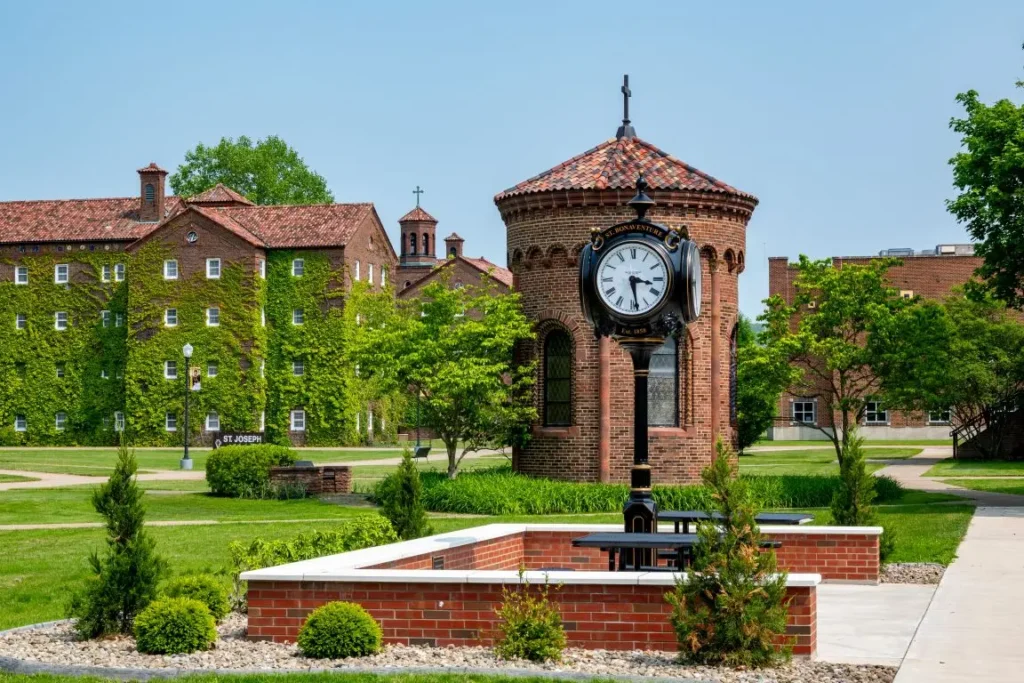
St. Bonaventure University offers graduate counseling programs that prepare you to serve individuals and communities through compassionate, research-based practice. The Master of Science in Education (MSED) in Counseling provides two distinct pathways: Clinical Mental Health Counseling and School Counseling. Both are designed to meet licensure requirements and professional standards.
The mission centers on preparing students for professional counseling practice in a multicultural and diverse society. Program goals support St. Bonaventure University’s broader mission and maintain the highest standards of counselor education. Both programs line up with standards set by CACREP (Council for Accreditation of Counseling and Related Educational Programs) and abide by principles from the American Counseling Association.
Your professional identity develops through three core values grounded in the university’s mission. You foster compassion for all individuals and believe in the worth and dignity of every member of society. You commit to seeking wisdom through intellectual pursuits and authentic living. You demonstrate integrity by accepting responsibility to practice as an ethical and competent reflective practitioner.
Since 2013, St. Bonaventure has delivered graduate counseling programs in an online environment created for distance learners. This approach maintains the university’s commitment to quality education dating back to 1858. Both Clinical Mental Health and School Counseling programs require 60 credit hours. Courses run one at a time with seven-week duration. You can focus on each subject before moving forward.
The programs cost $825 per credit hour, with total investment reaching $49,500 for 60 credit hours, excluding fees. You complete coursework through 100% interactive online delivery and eliminate travel requirements to the New York campus. Courses operate virtually, with the majority being asynchronous, though some live sessions enhance your learning experience.
Graduates achieve high pass rates on professional counselor exams. This success stems from focused curriculum, internship placement assistance and dedicated faculty support.
What counseling programs does St. offer?
Your choice between the two counseling programs at St. Bonaventure depends on the population you want to serve. The Clinical Mental Health Counseling track prepares you for work in community-based agencies. These include mental health centers, social services, college counseling and probation departments. This program trains you to become a licensed mental health counselor. Graduates are eligible to apply for licensure after completion. The 2024-25 graduates achieved a 100 percent pass rate on the licensed professional counselor exam.
The School Counseling track focuses on serving students in K-12 settings from elementary through high school. This degree meets the requirement for professional teacher certification in New York and qualifies you for Initial certification as a school counselor. School counseling certification in New York does not require a teaching certificate, notably. The Bureau of Labor Statistics projects 8 percent employment growth for school counselors from 2019 to 2029 due to rising student enrollment. Recent program statistics show 27 graduates with a 61 percent completion rate. The program also achieved 100 percent licensure examination pass rate and 100 percent job placement rate.
Both tracks require similar field experience hours. You complete 100 practicum hours followed by 600 internship hours divided into two 300-hour internships. Site supervisors must possess at least three years of experience. Clinical Mental Health supervisors need licensure as mental health providers. School Counseling supervisors must hold certification as school counselors.
The programs develop five core competency areas. You gain individual and group counseling skills through prevention and intervention approaches. Cultural competencies address diversity and advocacy while considering factors that influence different cultures. Communication training covers listening and boundary setting with empathy. Critical thinking enables you to review research to assess and diagnose. Business of counseling gets into your professional role and ethical responsibilities, among legal ones.
You can add an Advanced Certificate in the opposite specialization after completing either master’s program. This allows you to serve both clinical mental health and school settings.
Field experience is the foundation of St. Bonaventure’s counseling programs, with CACREP accreditation requiring students to work as counseling interns during their studies. The practicum begins your hands-on training with 100 hours on site and includes at least 40 direct hours working with clients or students at your assigned location. After this original experience, you complete two track-specific internships that each require 300 clock hours.
You maintain an active caseload during both internships and accumulate at least 120 direct client contact hours per placement. The supervision model combines on-site guidance from licensed professionals with in-class instruction. You then receive feedback from multiple viewpoints throughout your development.
SBU partners with you as you approach practicum and internship courses and provides direct support in finding placement sites. The placement process operates as a shared effort between you and the Director of Program Administration[102]. You should begin networking approximately six months before your practicum starts to ensure all approvals complete before beginning your field work.
Site supervisors must meet requirements set by the Office of Professions. Clinical Mental Health Counseling supervisors need at least three years of experience and licensure as mental health providers. School Counseling supervisors require three years of experience and certification as school counselors.
Your track determines the experiences you gain. School counseling interns work with the American School Counseling Association’s National Model, conduct classroom lessons, manage classroom environments and participate in interdisciplinary teamwork. Clinical mental health interns focus on evaluating, assessing and treating clients with mental health concerns while developing intervention strategies. The university supports you throughout the internship approval process to guarantee a high-quality experience that meets all program requirements.
CACREP accreditation distinguishes St. Bonaventure’s counseling programs. The university earned recognition for entry-level programs in both clinical mental health counseling and school counseling. This accreditation confirms that curricula, hands-on experiences, and faculty meet or exceed national standards. The 2024-25 graduates achieved a 100 percent pass rate on the licensed professional counselor exam. Focused curriculum design and dedicated faculty support made this result possible.
The New York State Department of Education approved the Clinical Mental Health Counseling program for diagnostic privilege designation. This approval expands your professional capabilities upon graduation and positions you to provide complete mental health services in clinical settings of all types.
St. Bonaventure became the nation’s first Catholic-Franciscan university in 1858. The university grounds its counseling education in values of compassion, wisdom and integrity. Online programs have operated since 2013 and maintain academic excellence through supportive environments tailored for distance learners. U.S. News & World Report recognized the university in 2025 as the #8 Best Value School in the North, along with rankings for state-of-the-art approaches and regional excellence.
Your learning benefits from a 15:1 faculty-to-student ratio. This enables individual-specific attention from instructors. Small class sizes create continuity in faculty interaction and enhance your educational experience. Faculty members remain available by phone and email through MySBU. They provide consistent support throughout your studies. You also receive guidance from a dedicated Student Success Advisor who supports you during challenges.
Course delivery combines multiple interactive elements. These include videos, live sessions, role plays, demonstrations and discussion boards. The network of over 31,000 alumni worldwide connects you with professionals committed to positive community effect.
St. Bonaventure is a military-friendly institution. The university offers a 30 percent tuition discount to all active military and makes advanced counseling education available to service members.
Next steps
Applying to St. Bonaventure’s counseling programs starts with using a personal email address rather than a school-issued one. This will give you admissions updates, reminders, and decisions without interruption, even after graduating from your current institution.
The admission committee reviews multiple components when thinking about candidates. You submit an application for admission, a statement of intent serving as your writing sample, and transcripts from all colleges previously attended. Two professional references are required from former professors, supervisors, or colleagues who can assess your knowing how to handle graduate work. References from family or friends will not be considered. The program director may request additional information during the review process, and you will participate in an interview.
Submit only replaceable documents like transcripts and test scores. Avoid mailing irreplaceable originals, as submitted materials become part of your application record and cannot be returned. You receive portal access within a few weeks to track your application status once you submit. The portal notifies you of any missing materials.