
Counseling Degrees from Nazareth University
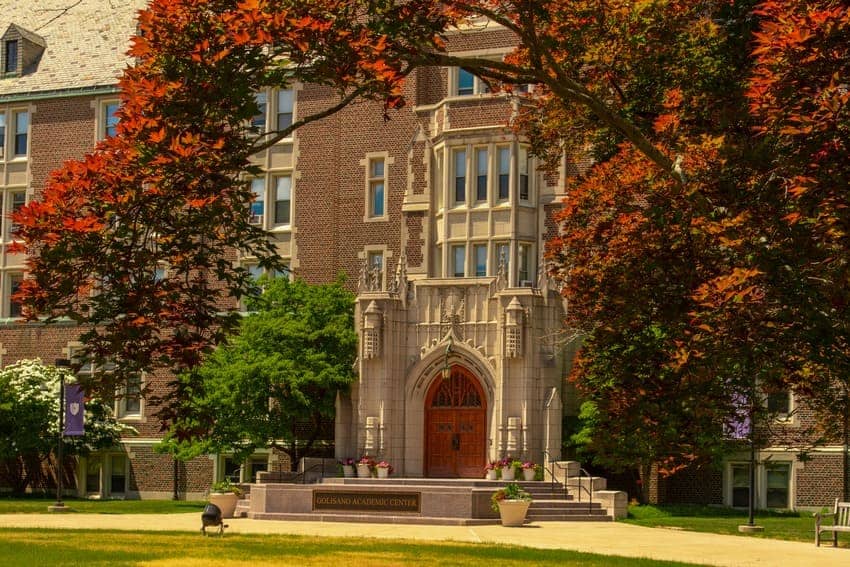
Nazareth University operates under the authority of the Board of Regents of the University of the State of New York and holds accreditation from the Middle States Association of Colleges and Schools. The institution delivers graduate level master’s programs and a Doctor of Physical Therapy program. Each program is designed to initiate or extend professional preparation in selected fields.
The graduate programs at Nazareth University share core institutional goals centered on creating an environment conducive to study and scholarship. Student development receives consistent emphasis. Nazareth maintains a commitment to strong student-teacher interaction as the foundation to achieve educational objectives, unlike many institutions. Graduate offerings at the university allow students to work with faculty and colleagues. They pursue knowledge, find it, evaluate it and disseminate it while applying it to human thought and behavior.
Three distinct colleges house the counseling degree programs at Nazareth University. The College of Liberal Arts, Sciences, Business, and Education serves students at both undergraduate and graduate levels. It promotes an environment where knowledge pursuit holds value beyond career preparation. The College of Interprofessional Health and Human Services operates with a specific mission: educating professionals who are culturally responsive and capable of working interprofessionally. They promote health, wellness and improved quality of life in the global community. The College of Visual and Performing Arts and Design rounds out the graduate offerings with programs in fine and performing arts.
Nazareth university degrees span multiple therapeutic disciplines. The Creative Arts Therapy (Art Therapy) Program guides students to a Master of Science degree. It is designed to fulfill educational requirements to pursue the Registered Art Therapist (ATR) credential through the Art Therapy Credentials Board. The School Psychology master’s program prepares graduates to become certified school psychologists. It covers all National Association of School Psychologists training standards required to apply to National Certification of School Psychology.
Nazareth offers growing options for online education beyond traditional on-campus learning. These include continuing education and for-credit graduate degrees. You can add certificates, annotations, extensions and specializations to some master’s programs. You may also pursue them as stand-alone sequences to boost your professional skills and marketability.
What counseling programs does Nazareth University offer?
The counseling degree programs at Nazareth University span multiple therapeutic disciplines within the College of Interprofessional Health and Human Services. Programs in Creative Arts Therapy include specializations in Art Therapy and Music Therapy, among other programs like Communication Sciences and Disorders, Nursing, Occupational Therapy, Physical Therapy, and Social Work. Students seeking meaningful, service-oriented careers are drawn to these health profession programs.
The school psychology master’s program represents one of only two such programs in the region. This 33-month, full-time, in-person program opens to anyone with an undergraduate degree and is available to career-changers or those with backgrounds in humanities, social sciences, or education fields. Students complete a practicum of 240 hours in year two and then move to a full-time internship of 1,200 hours in year three. School psychologists earn a median salary of nearly $85,000, higher than most other school-based educational roles. The annual mean wage in New York state ranges from $92,240 to $111,720.
The art therapy program operates through evening and daytime classes. You can complete it in two years full-time. This program holds accreditation from the Commission on Accreditation of Allied Health Education Programs upon recommendation of The Accreditation Council for Art Therapy Education. Students complete internships both on and off campus.
Social work offerings include both BSW and MSW programs. The MSW degree meets educational requirements to apply for the licensed master social worker examination in New York State upon graduation. Nazareth provides a three-course specialization track for students interested in addiction counseling. You can become prepared for New York State credentialed alcoholism and substance abuse counseling-trainee (CASAC-T) status by completing the CASAC track. Social work jobs are expected to grow 12% from 2020 to 2030, above the average for all occupations. Substance abuse and behavioral disorder counselor jobs show even stronger growth and are projected at 18% from 2022 to 2032.
Internships/Practicum at Nazareth
Experiential learning is a required component of Nazareth University graduate programs. Students show this through internships, field experiences, clinical placements, research opportunities and mentored creative activities. Approximately 300 students participate each year in the Professional Internship Program. They gain hands-on experience that develops marketable skills and strengthens professional networks.
Financial support reduces barriers to early career experiences. SPARK Grants provide USD 1,500 to cover costs for unpaid or underpaid positions. Combined with tuition scholarships for summer SPARK-eligible experiences earning credit, total support goes beyond USD 4,000 for a three-credit experience. This is a big deal as it means that students receive substantial funding. The average undergraduate student completes four career experiences during their time at Nazareth.
Psychology students pursuing internships register for PSY 483, a three-credit course requiring 120 hours minimum of work during one semester. Eligibility requires completion of at least 58 credit hours with junior standing, along with PSY 200, 201, and 202. You must maintain an overall GPA of 2.5 and a psychology GPA of 3.0. Internship sites span a variety of settings including ARC of Monroe, Compeer, Crisis Nursery, Lollypop Farm and the Mayor’s Office.
Social work practicum requirements differ by degree level. BSW students complete six hours weekly during junior year, totaling 144 hours. They then participate in four days weekly during their final semester for a minimum of 420 hours total. MSW generalist year students complete 12-14 hours weekly across a full academic year for 400 hours total. Advanced year students work 18-20 hours weekly for 500 hours in settings providing advanced clinical skills.
Education programs require at least 100 field experience hours for initial certification, with 50 additional hours needed for each additional certification. Nazareth partners with over 400 regional agencies and provides diverse placement options. On campus, you can deliver hands-on care at the York Wellness and Rehabilitation Institute.
What sets Nazareth University apart?
Faculty credentials distinguish counseling degree programs at Nazareth University from comparable institutions. All faculty members hold licenses as mental health professionals. Their backgrounds span art therapy, music therapy, marriage and family therapy, dance/movement therapy, mental health counseling, and play therapy. This brings diverse therapeutic perspectives into classroom instruction.
Real-life clinical practice informs teaching approaches at Nazareth University graduate programs. Emily Genovese joined the faculty in 2019 and owns Canalside Therapeutic Arts in Fairport, where she has worked as an art psychotherapist since founding the practice in 2017. Her career spans roles as Primary Therapist, Art Therapist, Addictions Therapist, and Supervisor. Students gain insights drawn from her direct clinical experience. Professor Genovese’s work extends to multiple systems of care, including school districts and substance abuse treatment centers. She also collaborates with legal systems such as courts, probation, and forensic services.
Sarah Brasse serves as Internship Coordinator for the Art Therapy Program and draws upon over 15 years of professional experience to guide graduate students through university and external supervision settings. She leads private supervision groups for art therapists pursuing board certification. She also helps with community-based art therapy initiatives.
Faculty members contribute to national accreditation bodies and professional organizations. Professor Genovese has served with the Education Committee of the American Art Therapy Association, the Accreditation Council for Art Therapy Education, and the Commission on Accreditation of Allied Health Education Programs. Cui Jing brings clinical experience from psychiatric hospitals, private practice, and nonprofit organizations serving low-income families. She has received national recognition that includes multiple scholarships from the American Art Therapy Association.
The teaching philosophy emphasizes interdisciplinary collaboration. Faculty members value working among nurses, psychiatrists, psychologists, speech-language pathologists, music therapists, physical therapists, occupational therapists, and educators. This prepares you to function within multidisciplinary treatment teams after graduation.
Next steps
Start exploring program options, requirements and course descriptions for counseling degree programs at Nazareth University. You can get contact information for program directors if you have questions about your area of interest. Set up an on-campus meeting or an online consultation with a Graduate Admissions counselor to discuss the application process. Campus tours give you firsthand experience of facilities. Virtual information sessions connect you with graduate faculty members in your chosen field.
Sign up for email updates to get reminders about application deadlines and program information. Each graduate program has an Affordability page that details costs, scholarships, grants, loans, graduate assistantships and any partner tuition discounts available. The application process varies by program. Most Nazareth University graduate programs require no application fee. Exceptions include ACCESS, Physical Therapy and Speech Language Pathology, which use separate applications.
You can submit your application online at the graduate admissions portal. Admissions committees review completed files after application deadlines. You will get an admission decision through official electronic notification within four weeks after all required documents arrive. An enrollment deposit is due upon acceptance and applied to your first semester tuition as a non-refundable payment. Applications submitted after stated deadlines undergo review on a space-available basis. Graduate assistantships are limited and competitive